
- Healthcare providers are most likely to trust multivitamins (65%), vitamin D (54%), and magnesium (50%) enough to recommend them to patients.
- Over 1 in 2 healthcare providers (51%) believe their patients have withheld or misrepresented their supplement use when asked about it.
- 89% of healthcare providers have had to correct a patient’s understanding of a supplement they heard about on social media; 68% of those who have to do that frequently believe those patients use TikTok for supplement information.
- 87% of healthcare providers believe their patients need to exercise more caution with the supplements they use than they currently do.
- Only 3 in 5 healthcare providers are confident in the clinical efficacy of commonly used supplements.
- While 20% of healthcare providers view supplements as essential tools in modern preventive care, 72% believe they are sometimes useful but overhyped.
Supplements are everywhere, and patients often bring questions into the visit before they bring the bottle. To understand how clinicians approach this trend, Tebra surveyed 215 healthcare providers about which supplements they recommended, which ones they avoid, and what worries them most.
Private practices should know that patients want guidance, but many are getting their information elsewhere. This gap creates a real opportunity to build trust through clearer conversations and safer, more consistent documentation.
Supplements clinicians trust most, and where they draw the line
Most private practices want to support patients with practical, evidence-informed choices while avoiding unnecessary risk to staffing capacity. That balance showed up clearly in which products clinicians felt comfortable recommending and which ones raised red flags.
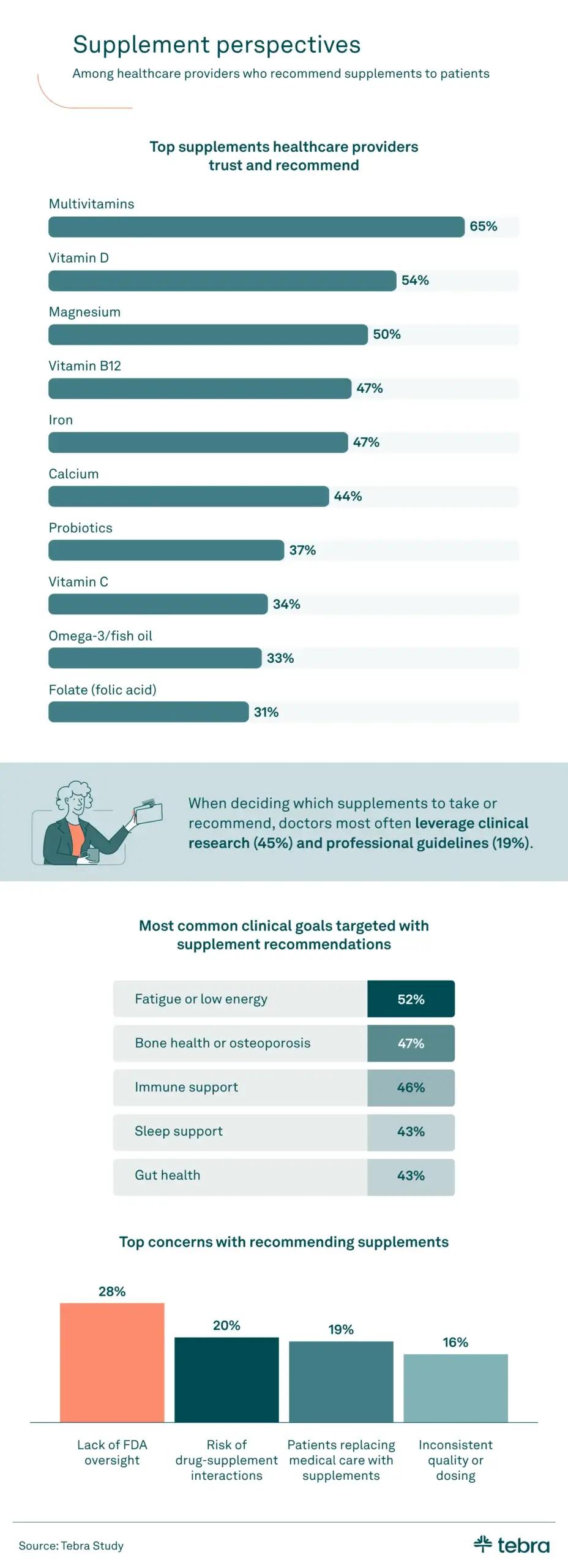
Healthcare providers most often trusted multivitamins (65%), vitamin D (54%), and magnesium (50%) enough to recommend, suggesting a preference for familiar options with clearer use cases. Healthcare providers were most likely to suggest supplements for:
- Fatigue or low energy (52%)
- Bone health or osteoporosis (47%)
- Immune support (46%)
Clinical decision-making leaned heavily on established evidence sources. When deciding what supplements to take or recommend, doctors most often leveraged clinical research (45%) and professional guidelines (19%).
Certain categories stood out as common "no" zones. Healthcare providers most often advised patients to avoid:
- Botanical or herbal products (11%)
- Amino acid supplements (10%)
- Nootropics (10%)
- Peptides (8%)
Oversight concerns shaped the conversation, too. Healthcare providers were most concerned about the lack of FDA oversight when recommending supplements (28%). Another 20% worried about supplements interacting with other medications.
To support patient safety and trust, private practices can create clear internal guidelines for supplement recommendations, focusing on well-researched options. Providing patients with evidence-based education and discussing potential interactions during visits can help guide smarter choices without compromising care.
Misinformation and missing details make supplement conversations harder
Even when clinicians were open to supplementation, they still needed accurate information to keep patients safe. Many providers reported that patients brought in supplement decisions shaped by non-clinical sources, creating extra work during visits that could be mitigated by digital intake and triage automation.

Nearly 3 in 4 healthcare providers believed their patients took supplements on their own accord or based on online sources instead of advice from a professional. Providers also believed patients were over 3 times more likely to learn about supplements from friends and family (65%) than their medical provider (21%), which shifted the clinician's role toward fact-checking and risk review.
Over 1 in 2 healthcare providers (51%) believed their patients had withheld or misrepresented their supplement use when asked about it, and 44% had felt pressure from patients to approve or support supplement use even when they were unsure about its benefits.
Behind all of this was a simple safety concern. Healthcare providers believed their patients needed to exercise more caution with supplements they used than they currently did (87%).
Social media drove a lot of the confusion. Many healthcare providers (89%) had to correct a patient's understanding of a supplement they heard about on social media. They most frequently had to correct patients' understanding of supplements from content viewed on TikTok (68%), Facebook (64%), and Instagram (61%). TikTok, Instagram, and Facebook are third-party platforms where trends lack clinical peer review.
Private practices can ease the burden of misinformation by using their EHR system to document supplement use, flag potential interactions, and prompt conversations during visits. Adding intake questions or digital forms about supplement habits can help uncover details patients might otherwise leave out. Sharing pre-vetted educational resources through the patient portal also gives providers a simple way to address social media myths and guide safer choices.
Providers see supplements as "sometimes helpful," but not a shortcut to care
Private practices often sit at the intersection of preventive care and patient expectations, requiring price transparency for out-of-pocket costs. That makes it important to define where supplements could support a plan, and where they could distract from proven treatment.

Only 3 in 5 healthcare providers were confident in the clinical efficacy of commonly used supplements, which helped explain why clinicians often approached recommendations carefully. Many providers saw supplements as a limited tool rather than a foundation of care.
Healthcare providers believed supplements were sometimes useful but overhyped (72%). Only 20% of healthcare providers viewed supplements as essential tools in modern preventive care.
When it came to patient education, providers wanted them to know that products labeled "natural" were not always safe (63%), supplements could interact with prescription medications (62%), and supplements were not substitutes for medical treatments (58%).
Conclusion
The survey results pointed to a steady middle ground. Many clinicians recommend a few well-known supplements for specific needs, but they stay cautious about oversight, interactions, and hype-driven products. Patients often arrive with strong opinions shaped by friends, family, and social media, which makes documentation and education even more important in private practices.
Clear intake workflows and confident counseling can reduce risk while strengthening the patient relationship. When practices guide supplement use with the same care as any other clinical decision, they help patients make safer choices and feel more supported.
Methodology
For this study, Tebra surveyed 215 healthcare professionals in late 2025 about their perspectives on supplement recommendations for patients.
About Tebra
Tebra, headquartered in Southern California, empowers independent healthcare practices with cutting-edge AI and automation to drive growth, streamline care, and boost efficiency. Our all-in-oneEHR andbilling platform delivers everything you need to attract and engage your patients, including online scheduling, reputation management, and digital communications.
Inspired by "vertebrae," our name embodies our mission to be the backbone of healthcare success. With over 165,000 providers and 190 million patient records, Tebra is redefining healthcare through innovation and a commitment to customer success. We're not just optimizing operations — we're ensuring private practices thrive.
Fair use statement
The information in this article may be used for noncommercial purposes only. If you share it, please include proper attribution and a link to Tebra.



Subscribe to The Intake: A weekly check-up for your independent practice