- Tracking KPIs supports KPI benchmarking and gives healthcare providers a clear read on performance, so teams can make data-driven decisions that lead to steady performance improvement.
- Using financial and patient care benchmarks against industry standards highlights strengths and gaps, and a simple dashboard keeps everyone aligned on what to improve next.
- Regular review of reports enables real-time course corrections, reduces wasted effort, and builds a habit of continuous performance improvement across operations and patient care.
Managing a healthcare clinic means juggling billing, marketing, operations, and patient care. Benchmarking key performance indicators gives you a clear way to evaluate results and make solid decisions. It also connects day-to-day work to broader business objectives and strategic planning across your organization’s performance.
Finding the right comparisons can be tough for small and mid-size practices. To help, Tebra fielded a proprietary survey of independent providers nationwide. The study included 290 practitioners who personally see patients and use electronic health records (EHRs). The survey benchmarks a core set of key performance indicators using consistent datasets, so each practice is measured on the same basis.
As you read, you’ll learn how to measure current efficiency and apply healthcare benchmarking to see where you excel and where to improve. Framing results within the healthcare system and local health systems helps you align goals, choose practical steps, and track progress over time. When you benchmark against industry standards and revisit your KPIs regularly, you create a simple loop for continuous improvement that supports clinical quality and operational performance.
Why benchmarking KPIs is crucial for independent practices
Benchmarking turns routine reporting into evidence-based action. When you compare your performance indicators to reliable peers, patterns appear. Strengths stand out. Gaps become specific. That clarity supports better decision-making at the front desk, in the exam room, and in finance.
It also builds a habit of continuous improvement. Teams review performance data, choose a small change, and watch how it moves key quality measures over time.
The loop is simple: Measure, compare, act, repeat. Independent practices don’t need massive budgets to benefit. They need a consistent process that links numbers to daily workflows and patient experience.


"When you compare your performance indicators to reliable peers, patterns appear."
Benefits of KPI benchmarking
Benchmarking helps practices raise the bar on quality of care, outcomes, and operational efficiency. By comparing results to trusted industry benchmarks, you can see where to invest, what to fix, and how to reach top performance without guesswork.
- Optimize resources: Use comparisons to tighten workflows, reduce waste, and improve resource allocation so teams spend time where it matters most.
- Pinpoint inefficiencies: Let the data surface bottlenecks and gaps, then target them with specific changes that move the needle on throughput and costs.
- Strengthen clinical quality: Track quality of care with concrete signals like patient safety, readmissions, and length of stay to guide protocols and coaching.
- Improve the patient journey: Align front-office, clinical, and billing steps around measurable patient experience metrics to reduce friction and boost satisfaction.
- Guide fair comparisons: Apply basic risk adjustment when reviewing outcomes across different populations or specialties, so comparisons stay meaningful.
- Inform strategy and goals: Use results to set grounded targets, monitor rankings within your market, and track progress against industry benchmarks.
- Support compliance and safety: Monitor indicators tied to patient safety and documentation, then address gaps before they become issues.
- Build a culture of improvement: Regular reviews encourage small tests, shared learning, and continuous updates that compound over time.
- Focus on what works: Let performance comparisons steer investments toward interventions with clear returns, and away from efforts that don’t move results.
Consistent KPI benchmarking turns scattered numbers into a practical plan. When teams see how their performance data aligns, decision-making becomes faster and more consistent across the organization.
A list of common KPIs for healthcare practices
Use different types of benchmarking, such as internal benchmarking, competitive benchmarking, and strategic benchmarking, to compare these common KPIs across similar peers. Include financial metrics and experience signals, such as NPS (Net Promoter Score), where relevant.
- Patient no-show rate: Patients who miss appointments without more than 24 hours’ notice.
- Accounts receivable >120 days: Claims with outstanding balances over 120 days within 1 rolling year.
- Insurance payment rate: Claims paid by insurers within 45 days of service.
- eRx rate: Medications sent electronically in the last 30 days.
- Time in EHR: Minutes per patient spent on documentation, patient history review, ordering labs, and prescriptions.
- Manual billing: Staff hours spent on manual billing activities per provider.

A step-by-step guide to benchmarking your KPIs
Follow the steps below to begin benchmarking your own KPIs.
Identifying relevant KPIs
Choosing the right key performance indicators helps healthcare providers focus their effort where it counts. Tie measures to business objectives and active quality improvement initiatives across clinical and administrative work.
- Align with goals: Select KPIs that support clear business objectives in your setting (primary care, outpatient, or other specialties).
- Cover core areas: Include finance, patient care quality, operational efficiency, and staff productivity so results reflect the whole practice.
- Split clinical and admin: Track metrics for clinicians separately from administrative KPIs to see where processes or care pathways need attention.
- Engage stakeholders: Involve physicians, admins, and patients so chosen KPIs are meaningful, actionable, and tied to real workflows.
"Involve physicians, admins, and patients so chosen KPIs are meaningful, actionable, and tied to real workflows."
Collecting data
Start with consistent data collection. Track weekly hours and volumes across core tasks so your internal data is comparable over time:
- Patient acquisition (business listings, marketing)
- Reputation management
- Patient retention
- Scheduling and reminders
- Patient communications
- Intake
- Care administration and documentation (EHR notes, labs, ePrescriptions)
- Manual billing and reimbursements
Supplement your internal data with trusted registries and gov datasets/data sets such as the CMS Data Portal. Combining sources improves accuracy and shows where your workflows need attention.
Analyzing performance
Once you identify your KPIs and collect results, analyze your benchmarking data to understand current operational performance and surface specific performance gaps.
- Evaluate current metrics: Review a clear baseline and compare to prior periods and peers. Note trends that affect throughput, accuracy, or experience, and record your calculation methodology for consistency in KPI benchmarking.
- Segment performance data: Break results into departments, roles, locations, or time frames. Segmentation helps confirm patterns, isolate issues, and prioritize fixes where the impact will be highest.
- Consistent analysis: Use a simple dashboard with near real-time updates for a handful of priority KPIs. Revisit the baseline after each change, confirm the shift, and standardize improvements that stick.
Comparing with industry standards
Comparing your KPIs with industry standards means reviewing how similar practices perform on the same measures. Use trusted industry benchmarks and local market rankings to see where your organization’s performance is strong or needs work.
Apply basic risk adjustment when clinics differ by specialties or case mix, so comparisons stay fair. This outside view helps set realistic targets, surface high-performing processes you can adopt, and avoid chasing noise. For definitions and approaches, see the CMS Innovation Center’s benchmarking overview.
"Use trusted industry benchmarks and local market rankings to see where your organization’s performance is strong or needs work."
7 common benchmarks to track at your clinic
Here are 7 KPIs every clinic should track.
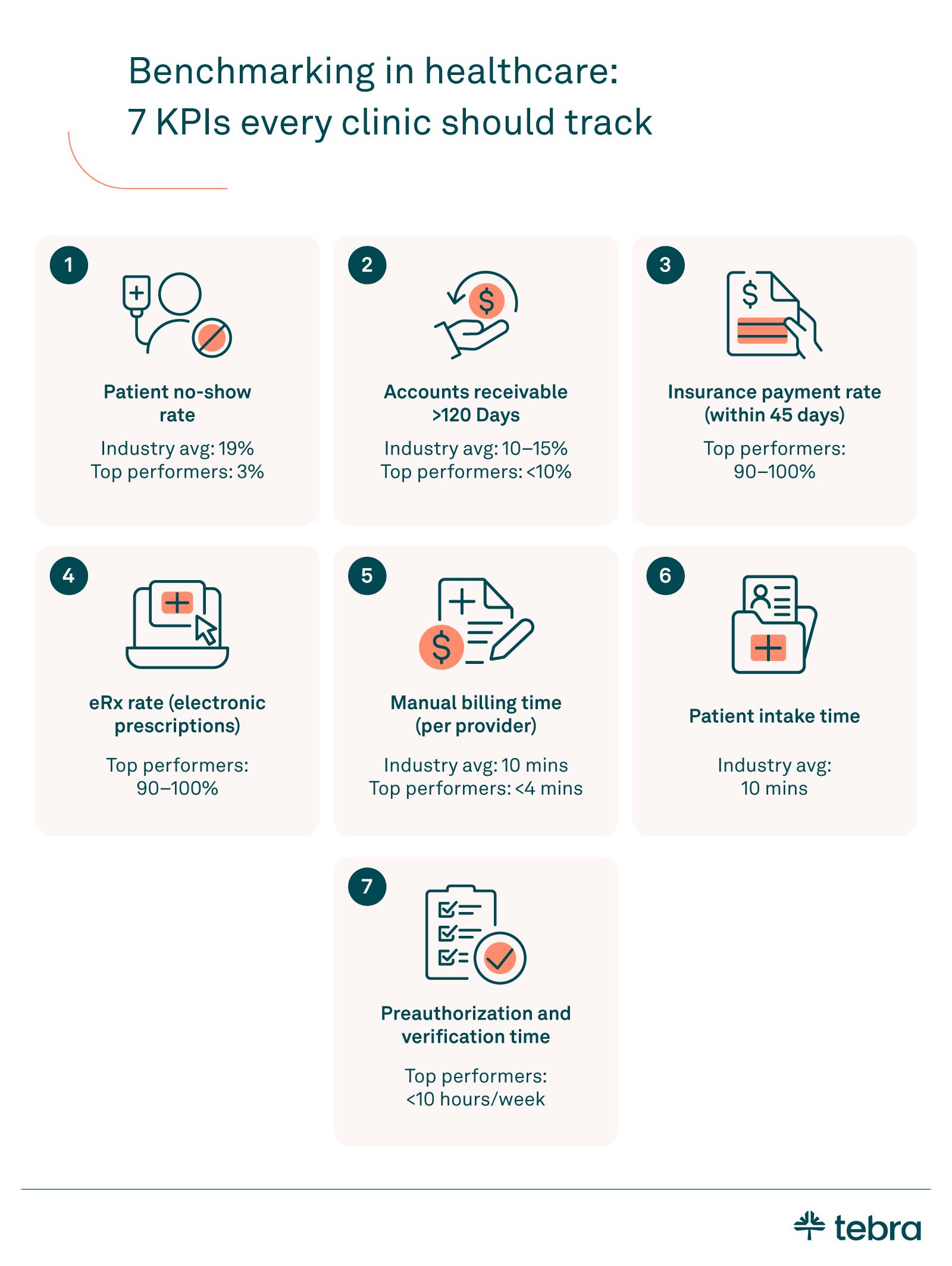
Let’s look at some industry standards from Tebra’s recent proprietary survey of independent healthcare providers nationwide:
1. Patient no-show rate
This metric examines the number of patients who miss appointments without more than 24 hours’ notice.
- Industry average: 19%
- Top performers: 3%
The patient no-show rate is a crucial KPI because it affects operational efficiency and revenue. High no-show levels waste appointment slots that could be used for other patients. Workflows slow down, and staff spend extra time rescheduling.
Reducing no-shows improves resource use and care continuity. It also supports patient satisfaction and the broader patient experience, since fewer gaps mean smoother visits and shorter waits.
If your rate is below the industry average, you likely have effective reminders and scheduling practices in place. That consistency supports retention rate and long-term customer retention.
Consider reminder texts and emails as part of your marketing efforts. Offer easy rescheduling, set clear confirmation steps, and review patterns by day and time to adjust templates.
Practice automation strategies to achieve this include implementing automated reminder systems, adopting flexible scheduling policies, or providing incentives for on-time attendance.
2. Accounts receivable over 120 days
This metric measures the percentage of claims with an outstanding balance over 120 days within a rolling year.
- Industry average: 10–15%
- Top performers: Under 10%
Keeping this number low protects financial health. High aging ties up cash, limits operating flexibility, and slows investments that drive revenue growth. Strong billing hygiene keeps money moving and stabilizes planning.
When the percentage is high, look for process issues. Common causes include coding errors, late submissions, and weak follow-up on unpaid claims. Treat it as a signal to review workflows, training, and accountability.
Automate wherever possible. Digital statements, text reminders, and claim edit tools reduce friction and speed collections. Automation that improves clean claims and timely resubmissions can lift financial metrics across the board.
Track impact beyond collections. Monitor net profit margin and estimate return on investment for automation tools so improvements translate into durable gains. Practices that shorten the timeline from charge to payment can confidently reinvest and support steady revenue growth.
"Digital statements, text reminders, and claim edit tools reduce friction and speed collections."
3. Insurance payment rate
This KPI tracks the percentage of claims with insurance payment received within 45 days of service.
- Top performers: 90–100%
A high payment rate within 45 days signals efficient revenue cycle work and healthy payer relationships. Prompt payments stabilize cash flow and make it easier to cover costs and invest in care.
Teams that excel usually pair automation with clear roles and strong training. They also monitor performance data closely to spot delays early and fix them before backlogs grow.
Tighten quality control at each step. Use claim edits and eligibility checks to prevent denials. Measure cycle time from charge capture to payment so you can see where files slow down.
If results lag, review workflows, retrain staff on edits and follow-up, and use technology that reduces manual touchpoints. Raising this rate improves financial stability and supports consistent patient care.
To reduce billing and insurance complexity:
- Use a billing system that connects the full reimbursement cycle and integrates with your EHR.
- Implement robotic process automation to hand off repeatable tasks.
- Use a system with a claims scrubber to catch errors before submission.
4. eRx rate
This KPI measures the percentage of medications sent electronically in the last 30 days.
- Top performers: 90–100%
A high eRx rate shows effective EHR use for prescribing, which improves accuracy and cuts administrative work. Electronic workflows reduce pharmacy call-backs and manual entry, so clinicians can focus on care.
Electronic prescribing also supports patient safety. Decision support can flag allergies, interactions, and dose ranges using evidence-based rules. Those alerts help teams avoid errors and strengthen healthcare quality at the point of order entry.
Low rates often signal limited training or underused EHR features. That can increase the risk of transcription mistakes, longer waits, and more staff time spent correcting orders.
Raise performance with brief training sessions, standard templates, and clear ownership for prescription cleanup. Track eRx use by provider, share quick wins at huddles, and pair reminders with refill workflows so adoption sticks. When eRx becomes the default, safety improves, visits run on time, and patients are more likely to follow their medication plans.
"When eRx becomes the default, safety improves, visits run on time, and patients are more likely to follow their medication plans."
5. Manual billing
This metric measures staff minutes spent on manual billing activities per provider.
- Industry average: 10 minutes
- Top performers: Under 4 minutes
Manual billing strains teams and budgets. Repetitive entry and corrections slow work and raise the chance of errors that lead to denials and delays. Less manual work improves operational efficiency and gives staff time for higher-value tasks.
Efficient practices use electronic tools for charge capture, edits, submission, and follow-up. These systems cut rework and speed the cycle from visit to payment. Track minutes by role and service line so you can see where time increases and why.
Review effort across a defined time frame and the same specific period each month. Consistent measurement supports fair comparisons and better resource allocation.
If your manual minutes are high, look for outdated steps or training gaps. Standardize workflows, add automation where clicks pile up, and set simple targets that teams can meet. As manual time falls, accuracy rises, and the billing cycle tightens. The result is steadier cash flow and more time for patient care.
6. Minutes per patient intake
This KPI measures the time spent collecting and entering patient data.
- Industry average: 10 minutes
Intake time shapes first impressions and overall flow. Long forms and manual entry increase wait times, frustrate patients, and reduce throughput. Shorter intake improves operational performance and keeps schedules on track.
Lower minutes usually signal streamlined steps and helpful technology. Patient portals and pre-visit forms cut retyping, lower error risk, and get people roomed faster. Teams can then focus on questions that matter.
Track intake alongside simple experience measures. Pair the metric with customer satisfaction feedback and a satisfaction rating after check-in. When intake drops and ratings rise, the process is working.
If your numbers run high, look for hand-offs that stall or repeated data entry. Standardize the sequence, simplify forms, and give quick training on efficient data capture. Small adjustments add up. Over several weeks, you should see smoother visits, fewer delays, and a better start to each appointment.
"Patient portals and pre-visit forms cut retyping, lower error risk, and get people roomed faster."
7. Time in preauthorization and verification
This metric measures the time spent on preauthorizing procedures and verifying insurance each week.
- Top performers: 70% of practices spend under 10 hours per week
Preauthorization and eligibility checks protect access to care and financial stability. They confirm coverage before services are delivered. Excessive time in these tasks delays care, ties up staff, and raises the risk of unpaid claims.
Efficient workflows shorten queues and improve cash flow. Teams that do well standardize request packets, track payer rules, and submit clean, complete information on the first pass. They also monitor status daily and close loops quickly when payers ask for more documentation.
Look for causes when time rises. Common issues include missing clinical details, unclear medical necessity notes, or inconsistent follow-up. A short checklist keeps packets complete. Templated language speeds charting and improves clarity for reviewers.
Adopt tools that automate status checks and use real-time eligibility. Modern systems pull benefits, copays, and prior authorization requirements in seconds. That reduces back-and-forth and prevents avoidable denials.
"Train staff on payer-specific rules and create an escalation path for stalled cases."
Treat this KPI like a gateway to smoother episodes of care. Upfront eligibility reduces last-minute cancellations and helps patients start treatment sooner. It also supports targeted interventions that can lower the length of stay and reduce readmission risk when patients transition between settings.
If weekly hours remain high, map the process. Note each hand-off, measure cycle time, and remove steps that don’t add value.
Train staff on payer-specific rules and create an escalation path for stalled cases. Track results month to month. As time lowers, staff capacity grows, patient access improves, and revenue becomes more predictable.

What to do next
For many providers, administrative work gets in the way of care. A simple plan helps. Start with a short list of KPIs, a basic template, and a shared dashboard so everyone sees the same numbers.
Use automation to cut repetitive tasks and support data-driven decisions. Connect scheduling, billing, and charting inside your EHR software so results update in near real time. Review progress monthly, adjust one or two workflows, and build continuous improvement into routine huddles. Book a free, personalized demo today to see how Tebra helps your practice achieve efficiency.
You have already mapped where time goes. Keep that momentum by downloading The Ultimate Guide to Practice Automation. It includes practical checklists you can apply this week.

About the survey
The results in this report come from an online survey fielded from October 30 to November 13, 2023. There were 291 respondents. Participants self-identified as physicians, nurse practitioners, and clinicians working in independent practices. All respondents personally see patients and use electronic health records.
Respondents represented multiple specialties, including primary care (36%), mental health (31%), pediatrics (18%), and other healthcare providers (15%). Most settings were ambulatory or outpatient clinics.
Findings reflect self-reported measures and comparable datasets collected during the field period. Results were not weighted.
FAQs
Commonly asked questions about benchmarking KPIs
You might also be interested in
Optimize your independent practice for growth. Get actionable strategies to create a superior patient experience, retain patients, and support your staff while growing your medical practice sustainably and profitably.
- Current Version – Nov 20, 2025Written by: Jean LeeChanges: This article was updated to include the most relevant and up-to-date information available.

Subscribe to The Intake: A weekly check-up for your independent practice