- Small, everyday inefficiencies like missed copays and no-shows quietly drain revenue over time.
- Verifying insurance and collecting payments upfront can cut claim rejections and speed reimbursements.
- Reduce no-shows and recover thousands in lost revenue by implementing automated reminders and easy rescheduling.
- Aligned services and integrated technology close gaps, boost efficiency, and protect your bottom line.
Revenue loss in medical practices often comes from small, hidden inefficiencies like missed copays, denied claims, no-shows, and disconnected systems. This webinar highlights how to quickly close revenue gaps by benchmarking performance, verifying insurance early, collecting payments at check-in, reducing no-shows with digital tools, and strategically adding services.
Integrated technology and streamlined workflows can help practices prevent leaks, improve efficiency, and protect long-term financial health.
Revenue leaks don’t always show up as a red flag on a report. For many practices, revenue loss is driven by missed copays, unresolved claims, frequent no-shows, and other ongoing issues that can drain income significantly over time.
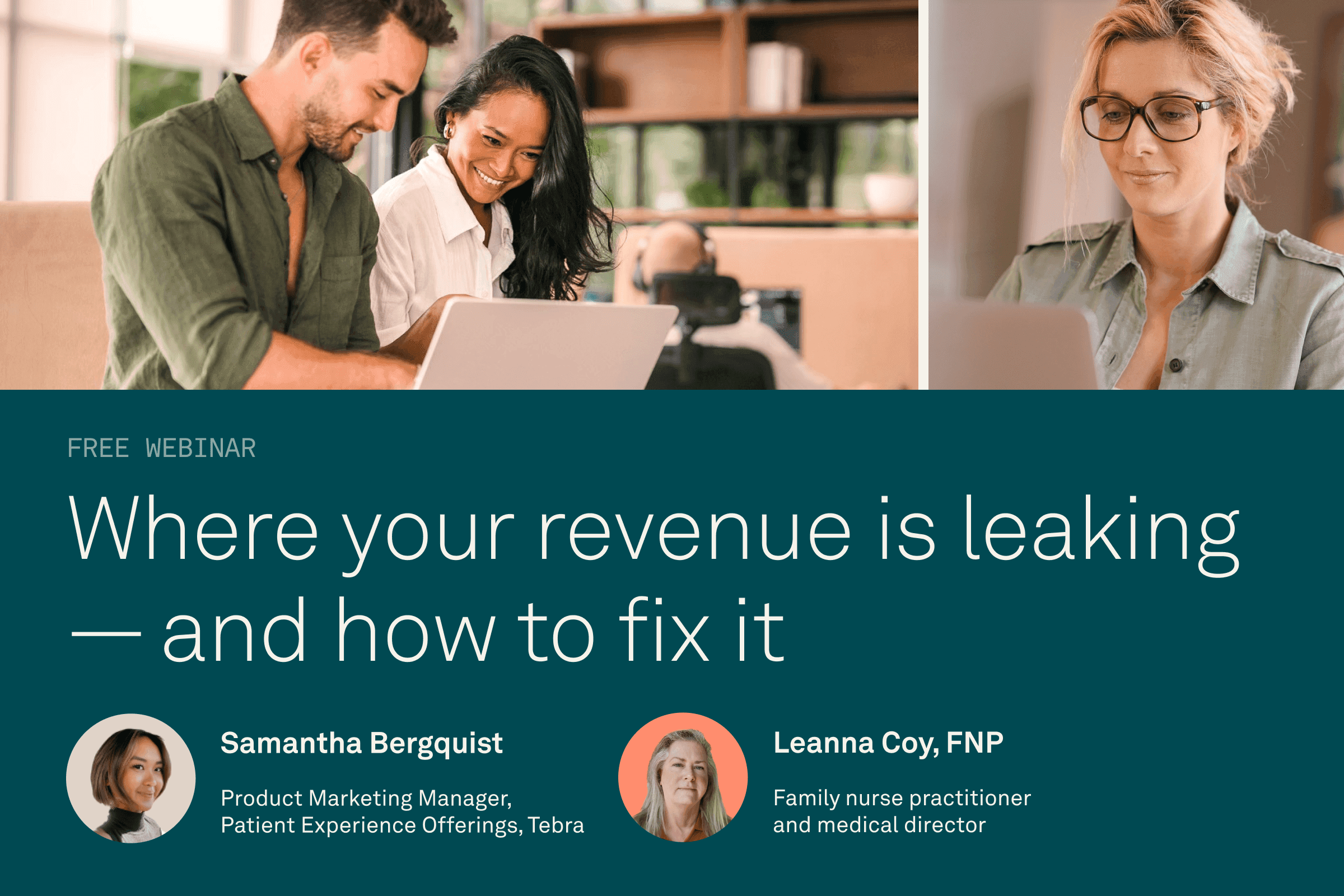
In the webinar "Where your revenue is leaking and how to fix it," Samantha Bergquist, product marketing manager for patient experience at Tebra, and Leanna Coy, FNP-BC, nurse practitioner and former medical director, share new insights from recent survey data. They also break down where to look to uncover revenue gaps and explore practical steps you can take to fix these leaks quickly, before they damage your bottom line.
Watch the webinar below to learn how everyday operational gaps affect revenue, and steps independent practices can take to prevent them.
The problem: silent financial leaks
Significant revenue loss rarely results from a single catastrophic mistake. Instead, it tends to emerge from small, everyday inefficiencies that go unnoticed. “These silent leaks quietly drain practices like yours every single month,” Samantha notes.
Common causes of financial leaks include:
- Missed copays
- Uncontested denials
- Slow payer follow-up
- No-shows and cancellations
- Inefficient workflows and technology gaps
Tebra’s data shows that verifying insurance before visits can reduce claim rejections by up to 70%, while reducing missed appointments could potentially recover between $3,200-$6,800 in lost revenue each month.
Benchmarking: Measure before you make changes
Before fixing revenue leaks, it’s critical to have a clear understanding of where your practice currently stands. Samantha encourages practices to examine critical areas where leaks are more likely to occur. This helps establish a baseline you can use to identify gaps, set goals, and measure progress over time. Practices can use the data shared in the webinar to compare their performance against current industry metrics.
Samantha and Leanna offer practical advice on how to fix revenue leaks and safeguard your practice’s financial future in the following areas.
Billing and collection: Prevent missed or delayed payments before they happen
In the webinar, Leanna points out that “increasing your collection of payments starts way before you see the patient.” Many practices don’t realize how many gaps can occur before the patient even checks out.

To improve billing performance, consider these steps:
- Verify insurance and patient information before every visit
- Collect payments at the time of service
- Stay current on coding updates
- Consider outsourced or hybrid billing models to improve consistency and reduce staff burden
These changes can make a significant impact. Tebra’s data shows 90% of practices that verify insurance ahead of time reduced claim rejections by up to 70%. Collecting payment at the time of service sped up reimbursements for 69%, and practices that improved coding accuracy saw a 30% improvement in reimbursement in less than 60 days.
Scheduling: Get more patients to show up for scheduled visits
Revenue loss from no-shows and cancellations is increasing, says Samantha.
Critical industry benchmarks include:
- Nearly half (45%) of patients have canceled a medical appointment in the last year
- 43% of providers have 10 or more cancellations or no-shows each month
- Almost 1 in 4 practices report losing more than $5,000 monthly due to no-shows
Patient no-show stats
Appointment reminders are crucial, and digital communication tools are more effective than phone calls. “If your patients are expected to wait on hold when they call your office instead of using the computer in their pocket to quickly reschedule,” explains Leanna, “you’re likely leaking revenue here.”
Things that help close scheduling gaps include:
- Automated, targeted appointment reminders
- Online rescheduling options
- Same-day or next-day availability
- Evening or weekend hours
- Running on time and clearly communicating delays
The good news is that reducing cancellations could help your practice recover up to $7,500 or more in lost revenue.
Ancillary services: Make sure new services add value and drive growth
Ancillary services can boost revenue and patient satisfaction, but only if they’re a good fit. When services don’t align with demand, scheduling, or reimbursement requirements, they can create new challenges rather than support growth.
A strategic approach helps you select services that solve real patient needs and integrate smoothly with existing operations.


"A strategic approach helps you select services that solve real patient needs and integrate smoothly with existing operations. "
Strategic planning steps to take before increasing your offerings:
- Assess patient demand before introducing new services
- Make sure services fit into the schedule
- Review legal and compliance considerations
- Confirm reimbursement and payer coverage
Tebra’s data shows:
- 68% of practices survey patients before adding new services
- 62% made sure new services fit into their existing schedule
- 58% of providers added up to 100 new patients
- 33% grew their practice by over 100 patients
- 17% added more than 250 patients.”
For 70% of practices, adding services brought in an additional $10,000 in annual income.
"For 70% of practices, adding services brought in an additional $10,000 in annual income."
Operations and technology: Fix processes and tools that slow down your team
Your billing and scheduling processes might look fine on paper, but revenue can still leak out through small operational gaps. The culprits are usually disconnected systems and manual tasks that undermine workflow efficiency and increase errors. "Behind every successful practice is technology that helps things run smoothly," says Samantha. When your systems don't talk to each other, revenue can disappear in ways that aren’t obvious at first glance.

Tebra’s practice management software helps independent practices close those operational gaps. Our all-in-one solution brings core systems together in a single platform, eliminating fragmentation between scheduling, billing, and clinical operations. Tebra uses automation and intelligent workflow tools to reduce staff burden, minimize errors, and enhance efficiency across your practice.
How Tebra helps reduce operational leaks:
- Automated insurance eligibility checks to prevent errors before visits
- Integrated claims functions that reduce denials and delays
- Patient-friendly scheduling, reminders, and communication
- Customizable EHR workflows that simplify documentation and day-to-day tasks
- Reliable infrastructure to minimize downtime and disruptions
Tebra provides a reliable infrastructure that minimizes downtime and disruptions, helping practices operate smoothly, protect revenue, and consistently deliver a high-quality patient experience.
Putting it all together: your revenue Rx playbook
The webinar brings these ideas together into a simple revenue Rx playbook that emphasizes visibility first, practical fixes second, and consistency over time.
Key takeaways:
- Verify patient information and eligibility before the visit
- Collect payments at check-in
- Work to reduce no-shows
- Add services that fit patient demand
- Adopt proven tools that address common revenue leaks
- Focus on protecting revenue and prevent small gaps from turning into ongoing losses
Download the slides here to access more insights and tips. Ready to take action? Schedule a free demo to see how Tebra integrates scheduling, billing, and patient experience tools that help you identify and fix revenue leaks and protect your bottom line.

- Current Version – Feb 06, 2026Written by: Jean LeeChanges: This article was updated to include the most relevant and up-to-date information available.


Subscribe to The Intake: A weekly check-up for your independent practice